A Degree Designed for Working Nurses

You already have valuable nursing experience. Now you’re ready to build on it. Webster University’s online RN to BSN degree program helps you develop the advanced nursing knowledge and leadership skills to pursue promotions, management roles and other opportunities where employers require or prefer a BSN. 

Apply NowRequest More Information

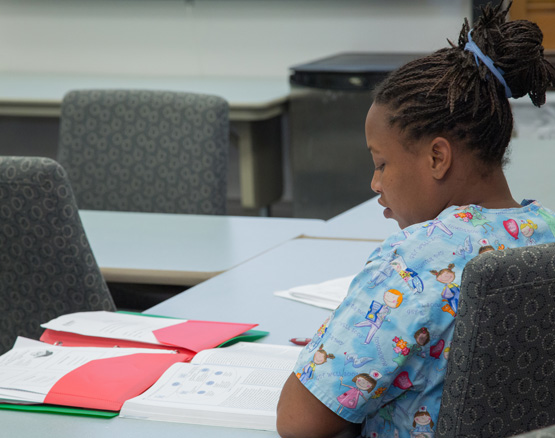
Webster nursing student wearing scrubs studying textbook and notes.

Program Overview: Online RN to BSN

Webster nursing student wearing scrubs studying textbook and notes.
  • Online coursework completed on your schedule
  • Full-time or part-time enrollment
  • Eight-week terms
  • Complete the program in 12–18 months full-time or 24–30 months part-time
  • Up to 90 eligible transfer credits accepted
  • Experienced educators with expertise in research, population and public health, behavioral health, nursing leadership and more
  • Curriculum focused on holistic health promotion

Why Earn Your Bachelor's Degree in Nursing?

Earning a BSN expands your nursing knowledge and skills while providing a credential that can advance your career. Many employers value BSN-prepared nurses for their critical thinking and expertise in leadership, case management and health promotion, according to the American Association of Colleges of Nursing. 

Some healthcare employers also require a BSN for leadership positions. Earning a BSN is also a necessary academic step toward a Master of Science in Nursing (MSN). As you compare BSN programs, consider how each curriculum supports your goals. 

Transcript

[Music]

Text on screen: Program Spotlight: RN-BSN Completion

Text on screen: Jody Spiess, PhD, RN, GCPH Associate Professor, RN to BSN Coordinator, Nursing

Jody Spiess: The nursing program at Webster does help deepen the nurse’s practice. So they come to us with a foundation of nursing skills, you know, starting IVs, things like that. We build upon that and give them a more global picture of nursing.

Text on screen: Career Advancement: Taking your Nursing Practice to the Next Level

A lot of the facilities, especially in the St. Louis area, but many facilities across the country, are pushing for nurses to have a BSN as a beginning degree.

Text on screen: Jane F. Student

Jane F.: I was already a professional functioning nurse, but what it did was it expanded my horizons and enabled me to be able to read statistical reports and research and be able to discern if it was good information.

Text on screen: DEEPER KNOWLEDGE OF HEALTH CARE

I couldn't really go any further in my nursing career without a BSN.

Text on screen: Social Responsibility: Understanding Health Care in a Global and Diverse Environment

Spiess: One of the things that makes our RN to BSN program unique is the amount of content that we spend on the social determinants of health, which are those factors that impact patient’s health that is not related to acute care.

Text on screen: Factors such as SOCIOECONOMIC CLASS, RACIAL and GENDER

A lot of people tend to think of nursing as a hospital, but there's so much more to that.

Jane: It also broadens my knowledge about community-based nursing.

[Footage of people putting non-perishable food into boxes labeled “Donation”]

It was a great segue for me to return to volunteering in the community, and now I volunteer every weekend at food outreach in preparing meals for people with HIV and cancer who are unable to prepare their own meals.

Spiess: They will have a much bigger picture of their patients, their patient’s families, and the environment in which their patient comes from and goes back to.

Text on screen: Flexible Learning: Online Courses for Working Professionals

It’s 100% online, and if you run the class in a way that you are going back and forth with students, talking with them throughout the week, I find that I get to know them better than I did one night a week in the classroom.

[Footage of Jody Spiess teaching a class online]

Jane: You can break it up during your day if you have some downtime during the day. You can access your studies and work on it at that time.

Spiess: So online, but we’re available.

Text on screen: ONLINE AND AVAILABLE

Jane: For me personally, Webster University was a small enough community. I didn't feel like I got lost and felt well supported, as well as developing personal relationships with my classmates. I just don't think I would have had that in a large university setting.

[Webster University logo animates on screen]

Text on screen: webster.edu

[Outro music]

Why Choose Webster for Your RN to BSN?

Webster’s RN to BSN program combines the flexibility working nurses need with a curriculum that helps you develop skills you can apply on the job. You will learn from experienced nursing professionals while building on your previous education and clinical experience. The bachelor’s degree program serves mid-career nurses preparing to pursue leadership opportunities as well as newer RNs planning for long-term career growth. 


In Webster University’s online RN to BSN program, you will learn to: 

  • Apply leadership skills that support quality care and patient safety
  • Evaluate research and evidence for use in professional nursing practice
  • Use information technology to support nursing practice
  • Understand how healthcare policy, finance and regulations affect the healthcare system
  • Advocate for patients in diverse and global environments
  • Collaborate with patients and other healthcare professionals
  • Apply health promotion and prevention principles to individuals and populations
  • Demonstrate professionalism in nursing practice

Apply Now

Curriculum and Course Structure

Coursework in the RN to BSN program connects nursing practice with broader questions about patient care, leadership and the healthcare system. Nursing core courses include:

RN to BSN Program

  • Concepts of Professional Nursing
  • Lifespan Health Assessment for RNs
  • Evidence-Based Practice for Nurses
  • Health Promotion and Education
  • Interprofessional Collaboration
  • Organizational and Systems Leadership
  • Population Health: Clinical Prevention with Families and Communities
  • Disaster Management: A Global Perspective
  • Health Care Policy, Finance and Regulatory Environments
  • Capstone Portfolio


Explore Degree Requirements

Hands working on a keyboard 

BSN Credit Requirements

You must complete 27 credit hours of nursing coursework in the RN to BSN program and at least 30 credit hours at Webster University. Depending on the courses transferred into the program, you may also need to complete the Global Citizenship Program and/or science or elective coursework to fulfill the degree requirements. 

Admission Requirements and Eligibility

All applicants to Webster’s RN to BSN program must provide:

  • Proof of an unencumbered U.S. RN license, or eligibility for RN licensure with an NCLEX exam scheduled within three months of beginning the program
  • Transcripts from nursing schools and all colleges where they earned academic credit
  • A cumulative GPA of at least 2.5 on a 4.0 scale
  • An undergraduate application and résumé

Applicants must also complete an advising consultation with a faculty member. Continued enrollment requires maintaining an unencumbered nursing license. 

Contact an Admissions Counselor Apply Now


Transfer Admissions and Articulation Agreements

Eligible RN to BSN students may transfer up to 90 credits to Webster. A transcript review determines how previous coursework applies, so the number of credits you have earned and the number that meet your remaining degree requirements may differ.

Webster University also has articulation agreements with community colleges that allow those who have earned an Associate of Applied Science in Nursing (AAS) to transfer directly into the BSN program. Participating schools include: 

  • East Central College
  • Jefferson College
  • Lewis & Clark Community College
  • Mineral Area College
  • Moberly Area Community College
  • Southwestern Illinois College
  • St. Charles Community College
  • St. Louis Community College

Explore the Transfer Credit Policy

Tuition, Financial Aid and Affordability

The admission team at Webster can provide an individualized cost estimate based on your transfer credit evaluation and planned course load. They also can help you explore financial aid options. Complete the FAFSA if you plan to seek federal student aid, and ask how your enrollment level affects available assistance.Explore Financial AidIf your employer offers tuition assistance, check its annual limit, reimbursement schedule, grade requirements and any commitment to remain employed after receiving benefits. 

Explore Tuition and FeesExplore Financial Aid

What Can You Do With an RN to BSN Degree?

Your career outlook after earning a BSN from Webster University is bright. Our nursing graduates work in clinical nursing, administration, case management, quality and safety and other areas. Employers include BJC HealthCare, SSM Health, Mercy Hospital St. Louis, St. Luke’s Hospital and the Veterans Health Administration.

According to nurse.org, nurses with a bachelor’s degree can earn between $5,000 to $20,000 more than the salary of an RN with an Associate degree alone. With an average annual salary in 2025 of $97,550 per year and a faster-than-average projected growth from 2025 to 2035, states the Bureau of Labor Statistics, your job will be in demand for years to come.

Three nursing students collaborating.

Frequently Asked Questions (FAQs) About RN to BSN Programs

It may be worthwhile if a bachelor's degree helps you meet an employer requirement or qualify for a promotion. It is also the next academic step toward earning an MSN. 

It takes about 24 to 30 months to complete Webster University’s RN to BSN program for part-time students and 12 to 18 months for full-time students. Your timeline depends on your transfer credits, remaining courses and enrollment choices.

Webster's online format and part-time enrollment option are designed for working adults. You can discuss a manageable course load with your advisor, taking into account work and family responsibilities.

If you are comparing online nursing programs, each school may approach clinicals and required activities differently. Webster’s RN to BSN program does not include traditional clinical rotations. Because the program is designed for licensed RNs, it focuses on advancing your existing nursing knowledge through online coursework. You will have practice experiences designed to be completed on your own time, offered in a flexible way.

Not automatically. Both can hold an RN license, and earnings depend on the position and employer. A BSN may expand access to higher-paying roles requiring a bachelor's degree.

Webster requires prior nursing education, qualifying licensure status, a minimum 2.5 cumulative GPA, transcripts, an application, a résumé and faculty advising. 

The fastest path for you depends on how many credits a school accepts and which requirements remain. At Webster, students typically complete the core nursing curriculum in approximately 12–18 months when attending full-time or 24–30 months when attending part-time. Your total timeline may be longer if you need additional degree requirements. 

They serve different purposes. RN to BSN programs build on prior nursing education. Accelerated BSN programs commonly serve people who already hold a bachelor's degree in another field and want to enter nursing.

Yes. Webster's RN to BSN program is accredited by the Accreditation Commission for Education in Nursing (ACEN).

Become Part of the Future of Nursing With an Online BSN

By entering the RN to BSN degree program at Webster University, you take the next step toward moving forward in your nursing career. The Webster University team can help you explore how the degree fits your career goals. 


Apply NowSchedule a VisitRequest More Information

Contact the Admissions Office to Find Out More

If you have more questions about the program, your application or other enrollment-related inquiries, contact our Admissions Office.

Call 314-246-7800 or 800-753-6765 or send an email to admit@webster.edu.

ACEN Accredited

RN to BSN and MSN Nursing Programs

The baccalaureate completion and master's nursing programs at Webster University, located in St. Louis, Missouri, are accredited by the:
Accreditation Commission for Education in Nursing (ACEN)
3390 Peachtree Road NE, Suite 1400, Atlanta, GA 30326
404-975-5000 | www.acenursing.org

The most recent accreditation decision made by the ACEN Board of Commissioners for the baccalaureate nursing program (RN to BSN) and for the master's nursing program (MSN) is continuing accreditation.

ACEN information about this program.

ACEN Accredited, Accreditation Commission for Education in Nursing